Introduction: Same goal, different paths
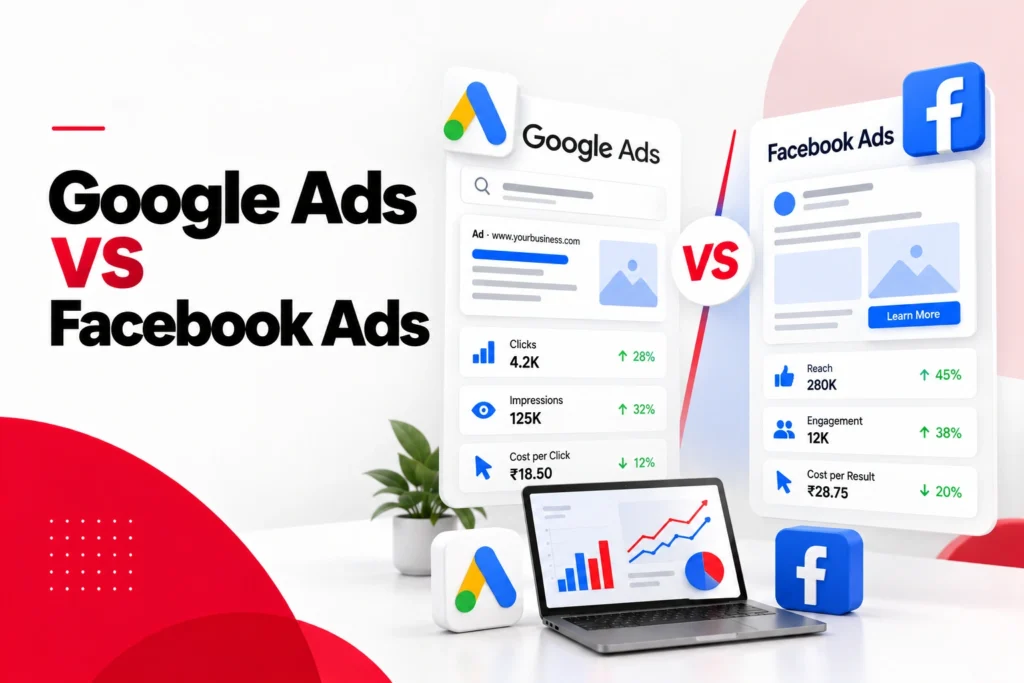
If in 2025 you were to decide between different paid channels, the question which is “best” is the one you would most likely ask. However, the wiser question would be to find out where each platform wins in terms of your funnel, margin structure, and creative capacity. Google Ads vs Facebook Ads is not a competition—it is a matter of choosing the tools that best suit your needs. One seizes high-intent demand at the very moment of a search; the other builds scalable attention with precision audiences and thumb-stopping creative.
In this guide, costs will be compared, ROI drivers, targeting, creative, measurement, and scaling playbooks will be discussed, that is why you are the one to decide how to deploy both for growth that is reliable.
Quick verdict (for impatient decision-makers)
- You use Google first when your products are problem-solution, you have good unit economics, or you need bottom-funnel revenue that is reliable.
- You use Facebook and Instagram first when you have visual storytelling, wide attractiveness, and the possibility to test creative angles at large.
- Top accounts in 2025 rely heavily the energy from one channel: they plow through ad campaigns on Google while preparing, opening, and extending their audiences on Meta.
The accounts that perform at the top level in 2025 are those that have both in their arsenal: they take advantage of intent on Google and at the same time they warm up, educate, and expand audiences on Meta.
1) Cost structures in 2025: what you really pay for
Both platforms auction attention; what differs is how the auction “values” you.
Google (Search, Shopping, PMax, YouTube, Discovery)
- For a pay you get clicks from the users with the highest intent. Those who are actively searching for the products/services that you offer will click on your ads.
- CPCs tend to be higher for more competitive keywords, but they provide a consistent value if the search queries are specific (brand + product, SKU, “near me,” “best + category + city”).
- Performance Max merges channels and focuses on results: if given pure conversion signals and first-party data, it can uncover attractive areas across Search, Shopping, YouTube,
- Invisible cost: data feed quality, landing page speed, and conversion tracking. Lack of proper infra increases CPCs and lowers ROAS.
Facebook/Instagram (Meta Ads)
- You pay for reach and relevance. CPMs vary by country, season, and creative quality.
- Advantage+ automation aggressively rewards great creative and broad audiences.
- Another side of the story: creative velocity. Without continuous testing (hooks, formats, offers), your broadcast will ramp up and your results will go down.
Bottom line: in Google Ads vs Facebook Ads, Google is charging you for what you get now, while Meta is charging you for the future audience. The smartest plan will use both just at the perfect time.
2) ROI mechanics: why each wins in different funnel stages
Where Google shines
- High intent: users already want a solution—your job is to be the best answer.
- Local & service: extensions, reviews, location assets, and business information reduce friction to call, visit, or book.
- Ecommerce with clear demand: Shopping feeds, promotions, and merchant ratings tilt the auction your way.
Where Meta shines
- Category creation & discovery: seed interest where no search exists (yet).
- Creative-led persuasion: video demos, testimonials, UGC, before/after—perfect for objection handling.
- Remarketing orchestration: sequences that educate, compare, and nudge.
The most intelligent Google Ads vs Facebook Ads for Business strategy visually connects creative and bidding to each phase: Meta attracts interest and energizes traffic; Google turns intent and re-engages impressions with brand searches.
3) Targeting & data in 2025: signals are the new currency
- Google: search phrases + product feeds + audience clues. Put in your customer lists, run the new customer value bidding, and support it with first-party conversions of high quality (server-side if possible).
- Meta: start with broad Advantage+, then develop with post-purchase value signals, site events (CAPI), and creative that is relevant to your true ICP.
In the case of Google Ads vs Facebook Ads for e-commerce, the effectiveness of the product feed (titles, attributes, GTINs, availability, price accuracy) for Google and the creative clarity for Meta have a direct correlation with ROAS.
4) Creative: what wins eyeballs (Meta) and clicks (Google)
- Meta: short-form vertical video (6–20s), UGC, fast cuts, on-screen captions, benefits up front, clear offer, simple CTA. Rotate concepts weekly; iterate winners with fresh hooks.
- Google: Ad assets are the big thing. Strong headlines, sitelinks, images, price/promo annotations, and merchant ratings lift CTR and quality. For YouTube within PMax/Demand Gen, take Meta-style videos and just make the first 2–3 seconds more eye-catching to get more hooks.
Tip: Develop a common “creative spine” (promise, proof, product, path) that can be changed for Google Ads and Facebook Ads to keep the same message.
5) Measurement & attribution: trust the direction, not a single number
- You can expect the Return On Ad Spend (ROAS) reported by the platform to be different from what you have in your backend. Google data-driven attribution can help you better allocate campaigns and thereby increase signal strength.
- On Meta, connect Conversions API and optimize for value where possible.
- Use experiments (geo-splits, PSAs, holdouts) quarterly to validate incrementality.
Smart decision for Google Ads vs Facebook Ads business: select one KPI (MER, CAC payback, LTV:CAC) as your beacon, use platform ROAS for day-to-day work but not as the final decision set.
6) Latest local update (GMB/GBP) you should know—and why ads must adapt
In 2024, Google decided to discontinue the in-profile messaging for Business Profile by Google – chat and call history. Basically, it means that there will be fewer interaction/conversation touchpoints in the SERP but more reliance on your website, calls, bookings, and store visits.
- Lean harder on location assets, call assets, and lead forms in Google campaigns.
- First, ensure that your GBP is showing up-to-date hours, categories, photos, and reviews—these are the elements that extend ads and ad rank for local intent.
- Moreover, if you were directing chat via GBP to prospects, then make a clear CTA in ads (book, call, WhatsApp/site chat) to replace that route and manage them as primary conversions.
While this shift in Google Business Profile (GBP) does not determine whether Google Ads or Facebook Ads is more effective, it elevates the importance of Google’s local ad surfaces, such as Maps and location-based Search. To capitalize on these opportunities, businesses must prioritize GMB optimization and implement tighter conversion tracking to ensure maximum visibility and engagement.
7) E-commerce deep-dive: who wins which SKU?
Google Ads vs Facebook Ads for e-commerce usually breaks down like this:
- High-intent SKUs (compatibles, refills, known brands): Google Shopping + Search dominates.
- Novelty/aspirational SKUs (beauty, wellness, apparel): Meta shines with UGC + bundles + offers.
- High AOV/lower frequency: Both work, but educate on Meta and close on Search/Shopping.
- Subscriptions: Meta for story + trial; Google for “best [product] subscription” queries.
Playbook: Seed interest via Meta (video + UGC) → harvest brand searches on Google → reengage with both (Meta DPA + Google Demand Gen/YouTube). This is Google Ads vs Facebook Ads as a system, not a discussion.
8) Budgets & scaling: a practical split for 2025
A reliable starting point if you don’t have historical data:
- 40–60% Google if you have measurable search demand and healthy margins.
- 40–60% Meta if your category relies on creative and education.
- Shift 10–15% monthly toward the platform with lower blended CAC over the last 28–60 days.
Purposely, if you are an advertiser and don’t know what to do then you should always protect the floor: first, fund branded + high-intent search, then with the leftover budget, you can go wider with Performance Max and Meta Advantage+.
9) Campaign architectures that work now
- Search: Use of SKAG-style intent groups has been phased out. Just you see how consolidated campaigns, exact + broad with intelligent negatives, well-built ad assets, and value-based bidding work out.
- Shopping/PMax: Clean feed, promotions, audience signals, new-customer value uplift, and brand exclusions where needed.
- YouTube & Demand Gen: Your task is to make short, hook-heavy videos; to let PMax/Demand Gen find cheap attention quickly while Search/Shopping get the final touch.
Meta
- Advantage+ Shopping for ecom; Advantage+ Lead/Website for services. Broad audiences + creative variety.
- Creative pods: 3–5 distinct concepts live at once (testimonial, demo, comparison, founder story, offer). Kill or iterate weekly.
- Remarketing under tight frequency caps; focus on social proof and offer clarity.
The architectures change, but these are the points of maximum automation in Google Ads vs Facebook Ads for 2025.
10) Offers & landing pages: where profit is actually made
- Offer hierarchy beats clever copy: price, bundle, guarantee, urgency, and risk reversal.
- Landing pages must load <2s, render cleanly on 4G, and match the promise in your ad.
- Use modular sections (problem → solution → proof → offer → FAQs) and trust badges.
- For local: frictionless tap-to-call, map directions, appointment booking, and above-the-fold reviews.
It’s rarely Google Ads vs Facebook Ads that breaks performance; it’s the offer–page mismatch.
11) Creative & copy frameworks you can steal
For Meta (attention first)
- Hook (2–3s): “3 reasons I stopped using X…”
- Value: demo + outcomes + proof.
- CTA: “Get 20% off today” or “Try risk-free.”
Run each concept in square and vertical; add subtitles; test first frame aggressively.
For Google (clarity first)
- Headlines: benefit + keyword + proof (“Faster Payroll in 5 Minutes | Free 30-Day Trial”).
- Descriptions: objection handling + CTA.
- Assets: sitelinks (pricing, bundles), callouts (warranty, free shipping), images, structured snippets.
Use aligned themes so Google Ads and Facebook Ads reinforce each other.
12) Bidding & pacing: let the machine learn (but feed it properly)
- Google: Start with tCPA/tROAS only when you have stable conversion volume; otherwise, begin with Maximize Conversions with targets later. Feed offline conversions (qualified lead, SQL, first order margin).
- Meta: Optimize for purchase value where possible; broaden targeting; scale winners by budget or duplication, not wholesale restructuring.
If your Google Ads versus Facebook Ads for business plan is a constant learning reset (constant edits, fragmented campaigns), then you are handing over margin to your competitors for free.
13) International & local nuance
- Regional CPM/CPC differences are large. Anchor budgets to LTV and logistics reality, not vanity geo-expansion.
- For local services, call quality matters as much as lead volume. Score calls and optimize toward qualified events on both platforms.
- Keep GBP spotless—accurate hours, categories, photos, and reviews augment your Google ad relevance, raise CTR, and improve conversion rates from local extensions.
14) Your 30-day action plan
Week 1—Audit & tracking
- Verify conversion events (server-side where possible), dedupe, and pass value where available.
- Fix speed, UX, and message match on top 5 landing pages.
Week 2—Offer & creative
- Ship 3 Meta concepts × 3 hooks (9 total).
- Refresh Google assets: 15 headlines, 4 descriptions, new image assets, promotions.
Week 3—Structure & budgets
- Consolidate Google campaigns; launch/clean PMax with strong signals.
- Launch Advantage+ with broad; cap remarketing frequency; set daily learning budgets.
Week 4—Decisions & scaling
- Shift 10–15% budget toward the platform with lower blended CAC and higher contribution margin.
- Book next month’s creative shoots; line up seasonal offers.
This is the Google Ads vs Facebook Ads question that if you follow this rhythm, turns into a quarterly allocation discussion, not guesswork.
Conclusion: Don’t choose a platform—choose a system
Profitble development in 2025 will be derived from the successful implementation of the user’s intent and focus. Operate Google Ads versus Facebook Ads as two complementary tools: Meta generates the need for the product and demonstrates the value of your business; Google makes the demand capture and closes the deal efficiently. Combine them with accurate data, eye-catching deals, rigorous creative testing, and an excellent local presence (even with a recently updated Business Profile). This is the way to decrease blended CAC while increasing LTV and growing your business without any unexpected results.
